Shock-Absorbing vs. Standard Casters: What’s the Difference and When Are They Essential?
Why Do Some Machines Vibrate Excessively While Others Remain Perfectly Stable?
In industrial machinery, medical carts, logistics equipment, and precision instruments, casters may seem like minor components, but they directly dictate the overall user experience and equipment stability. When selecting casters, many users focus solely on load capacity and dimensions, completely overlooking a critical factor: Vibration Control.
In reality, equipment encounters vibrations from two primary sources during daily operation and movement:
-
Floor Conditions: Concrete, tile joints, or uneven surfaces.
-
Internal Operation: Vibrations generated by the equipment itself, such as motors, compressors, or mechanical structures.
If these vibrations are not effectively absorbed, their long-term accumulation leads to decreased operational precision, loosened hardware, increased noise levels, and ultimately, a reduced overall lifespan for the equipment.
Therefore, for applications demanding high precision and stability, Shock-Absorbing Casters (Spring-Loaded Casters) have evolved from an optional upgrade into a mission-critical design element.
1. What is a Shock-Absorbing Caster? The Core Difference vs. Standard Casters
Standard Casters primarily consist of a wheel and a basic rig. Their structure is straightforward, focusing purely on load-bearing and mobility. These casters are suitable for smooth, flat floors and low-impact environments. However, they lack vibration absorption capabilities; when encountering uneven floors or dynamic loads, impact forces are transmitted directly into the equipment chassis.
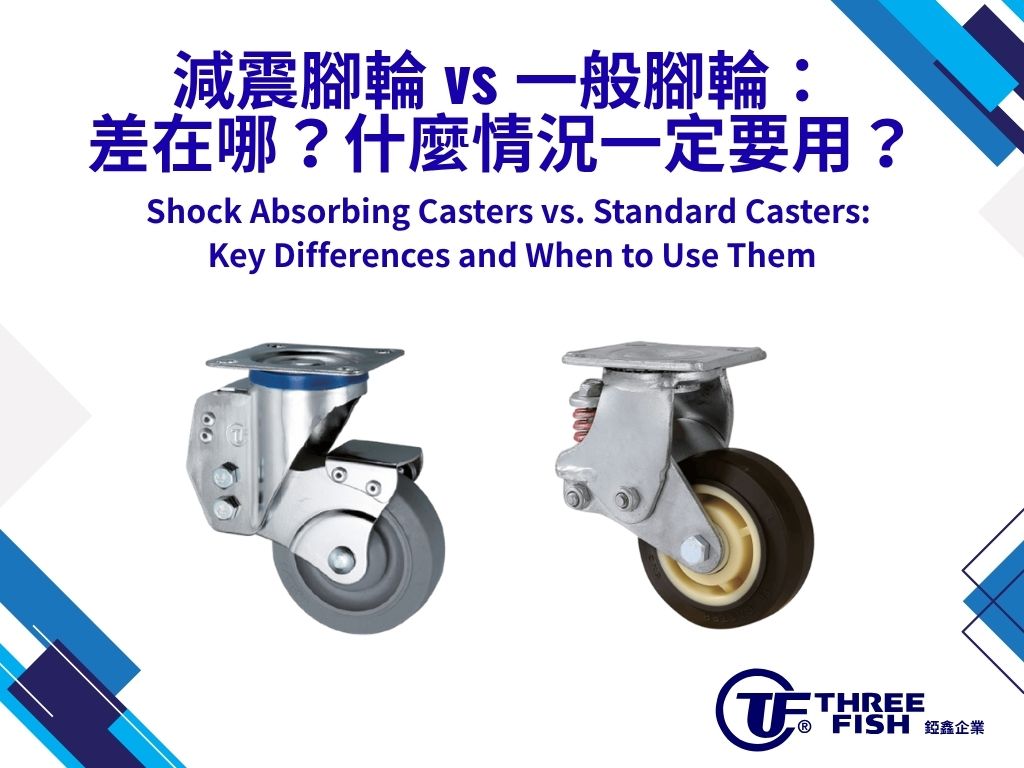
Shock-Absorbing Casters, on the other hand, integrate dampening mechanisms—such as metal springs, rubber blocks, or composite dampeners—into their structure. These designs allow the caster to absorb impacts from both the floor and the equipment while bearing the load. This effectively isolates the transfer of vibration, ensuring the equipment remains significantly more stable during transit and minimizing stress on internal structures.
The greatest difference between the two lies not just in their functionality, but in their profound impact on "Equipment Protection" and "Operational Quality."
2. Comparison: Shock-Absorbing vs. Standard Casters
| Feature / Comparison | Standard Casters | Shock-Absorbing Casters |
|---|---|---|
| Structural Design | Simple wheel and rig assembly | Built-in spring or rubber dampening mechanism |
| Shock Absorption | Negligible | Effectively absorbs impacts and vibrations |
| Rolling Stability | Prone to wobbling | High stability |
| Noise Level | Noticeable | Significantly reduced |
| Floor Adaptability | Suitable for flat surfaces | Adaptable to uneven surfaces |
| Equipment Protection | Lower | Reduces vibration transfer |
| Service Life | Shorter | Longer |
As the comparison shows, the value of shock-absorbing casters extends far beyond mere comfort; they comprehensively influence equipment stability and longevity.
3. When Are Shock-Absorbing Casters Absolutely Essential?
-
Precision Equipment In semiconductor manufacturing, optical inspection, and metrology equipment, even microscopic vibrations can ruin measurement results and process accuracy. Shock-absorbing casters effectively isolate external vibrations, maintaining stable operation.
-
Medical Equipment Medical carts, hospital beds, and diagnostic instruments require a quiet and smooth mobile environment. Shock-absorbing casters reduce noise and minimize vibrational interference, improving the quality of patient care and staff operation.
-
Uneven Flooring Environments Factories, concrete floors, or outdoor settings often feature expansion joints and uneven thresholds. Standard casters cause the equipment to bounce and suffer impacts, whereas shock-absorbing casters swallow these irregularities, ensuring smooth transit.
-
High-Value Assets Expensive, capital-intensive equipment demands maximum stability. Chronic vibration can cause fatigue or premature wear on internal components. Using shock-absorbing casters effectively extends the asset's lifespan and mitigates repair risks.
-
High-Frequency Mobility Scenarios In logistics and warehousing, equipment is moved constantly. Shock-absorbing casters reduce operator fatigue and boost overall workflow efficiency.
4. Decoding the Structural Design of Shock-Absorbing Casters
The performance of a shock-absorbing caster is primarily dictated by its internal dampening mechanism:
-
Spring-Loaded Dampening: Utilizes metal springs to absorb massive impact forces. Ideal for heavy-duty equipment and high-load environments.
-
Rubber Dampening: Uses elastomer/rubber blocks to absorb high-frequency micro-vibrations. Offers excellent noise reduction, making it perfect for medical and indoor environments.
-
Composite Dampening: Combines both springs and rubber to simultaneously swallow large impacts and eliminate fine vibrations. Commonly used for high-end and ultra-precision equipment.
Each structure has its distinct advantages and should be selected based on specific application requirements.
5. The Hidden Costs of Choosing the Wrong Caster
Using standard casters in environments that require shock absorption often leads to long-term, overlooked expenses. These include decreased equipment precision, structural loosening, elevated noise levels, and increased maintenance frequency.
These "hidden costs" accumulate over time, ultimately dragging down overall operational efficiency. Therefore, correctly assessing your requirements during the initial design phase is far more cost-effective than attempting retrofits later.
6. The Holistic Value of Shock-Absorbing Casters
The value of a shock-absorbing caster is not limited to a single feature; it impacts the entire system. Proper dampening design enhances equipment stability, slashes vibration and noise, extends service life, and dramatically improves the user experience.
In modern industrial and medical applications, these factors have become critical differentiators that determine product quality and market competitiveness.
Frequently Asked Questions (FAQ)
Q1: Do shock-absorbing casters increase rolling resistance (making them harder to push)?
A: Well-designed shock-absorbing casters strike a balance between shock absorption and rolling efficiency. Generally, they do not noticeably increase the effort required to push the equipment.
Q2: When are shock-absorbing casters unnecessary?
A: If the operating environment features perfectly flat, smooth floors and the equipment is not sensitive to vibration, high-quality standard casters are sufficient.
Q3: Do shock-absorbing casters last longer?
A: Yes. Because impact forces are absorbed, the internal structures (like bearings and brackets) endure significantly less stress, resulting in a longer operational lifespan.
Q4: Are they suitable for medical equipment?
A: Highly suitable. They are essential for effectively reducing noise and enhancing the stability of sensitive medical devices.
Q5: Can shock-absorbing casters be customized?
A: Yes. They can be selected or custom-engineered based on specific load capacities, environmental conditions, and operational requirements.
Conclusion: The Key to Enhancing Equipment Stability
In most industrial and medical applications, casters are not just mobility tools; they are vital components that dictate equipment stability and operational quality. By absorbing impacts and vibrations, shock-absorbing casters effectively shield equipment from hostile external environments, making them an indispensable element in high-end equipment design.
Compared to standard casters, shock-absorbing models deliver a vastly superior pushing experience, lower noise profiles, and extended durability. For precision equipment, medical applications, and high-frequency transport scenarios, their value far exceeds the initial difference in cost.
Eliminate Vibration and Instability at the Source When equipment suffers from excessive vibration, noise, or difficult maneuverability, the root cause is often the wrong choice of casters. Implementing the right shock-absorbing caster design can cure these problems at the source, elevating the overall user experience and equipment quality.
TFCaster has been dedicated to the design and manufacture of industrial and medical casters for decades. We provide tailored shock-absorbing solutions based on your specific application criteria. If you have advanced requirements for equipment development or caster selection, we recommend reaching out for a professional consultation to find your most stable and durable configuration.