Leveling Feet vs. Casters: Understanding the Differences and When to Use Which
The Critical Choice Between Equipment Stability and Mobility
In industrial machinery, automated production lines, medical instruments, and logistics systems, "support and mobility" consistently remain crucial elements of equipment design. When planning equipment architecture, many enterprises frequently encounter a deceptively simple yet critical question: Should we specify leveling feet or casters?
Although both leveling feet and casters are installed at the base of equipment, their design purposes and application scenarios are fundamentally different. An incorrect choice can lead to equipment wobbling, difficulty in positioning, and ultimately compromise production quality and operational safety.
From a practical engineering perspective, this article will provide an in-depth analysis of the differences between leveling feet and casters. Drawing upon TFCaster's extensive application experience in this field, we will outline the optimal selection strategies for various operational scenarios.
1. What are Leveling Feet? What are Casters?
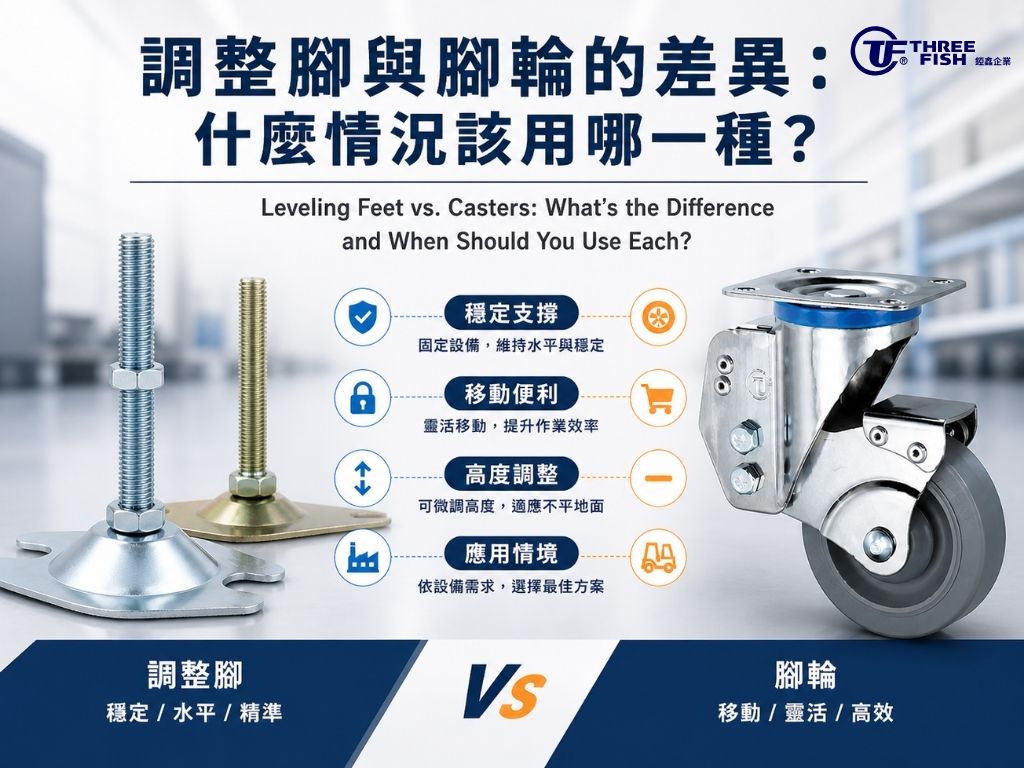
Leveling Feet (Leveling Mounts / Levelers) are stationary components designed to support equipment and adjust its height. Typically consisting of a threaded stem and a base, their primary function is to ensure equipment remains perfectly level and absolutely stable, even on uneven floors. They are widely utilized in heavy machinery, automated assembly lines, and precision diagnostic instruments.
Casters, on the other hand, are wheeled components designed to facilitate mobility, allowing equipment to be moved freely between different locations. Depending on their structural design, they are categorized into swivel casters, rigid (fixed) casters, and locking (brake) casters. They are ubiquitous on logistics carts, medical apparatus, and mobile workstations.
The core distinction between the two is straightforward: Leveling feet prioritize "Stability and Support," whereas casters prioritize "Mobility and Flexibility."
2. The Core Differences Between Leveling Feet and Casters
| Feature / Comparison | Leveling Feet | Casters |
|---|---|---|
| Primary Function | Stationary support and equipment leveling | Mobility and material handling |
| Mobility | Stationary (Immobile) | Highly mobile (Freely movable) |
| Stability | Extremely high; ideal for long-term placement | Moderate; relies on braking mechanisms for stability |
| Height Adjustment | Precise height adjustability | Generally fixed height (Non-adjustable) |
| Floor Adaptability | Uneven surfaces or applications requiring leveling | Smooth, flat surfaces or applications requiring frequent movement |
| Load Capacity | High; designed for constant, heavy loads | Varies significantly by specific model |
| Operational Convenience | Difficult to reposition once installed | Allows for rapid relocation and repositioning |
As the comparison illustrates, leveling feet and casters are not direct substitutes for one another. The optimal choice depends entirely on the equipment's specific requirements and its operational environment.
3. When Are Leveling Feet the Right Choice?
-
Precision Equipment & Machinery For CNC machining centers, optical inspection systems, and semiconductor equipment, absolute stability vastly outweighs mobility. Leveling feet allow for micro-height adjustments to ensure the equipment is perfectly horizontal, which is critical for maintaining strict machining and measurement tolerances.
-
Long-Term Stationary Equipment If equipment does not require frequent relocation after installation—such as automated production lines, heavy-duty conveyors, or fixed workstations—leveling feet provide superior, reliable, and rigid support.
-
Uneven Flooring Environments Factory floors or older facilities often feature surface irregularities. Leveling feet effectively compensate for these height discrepancies, preventing equipment tilt and uneven stress distribution on the machine frame.
-
Heavy-Duty Applications Leveling feet generally boast a significantly higher static load capacity than casters. They are ideal for sustaining heavy machinery over extended periods and mitigating structural fatigue.
4. When Are Casters the Right Choice?
-
Equipment Requiring Frequent Relocation For logistics carts, tool trolleys, and medical diagnostic devices that must move seamlessly between different zones, casters drastically improve operational efficiency and workflow.
-
Warehousing & Material Handling In distribution centers and warehouses, casters minimize manual labor, accelerate material transport speeds, and streamline the supply chain.
-
Versatile / Multi-Purpose Equipment Equipment deployed across various locations, such as mobile testing units or temporary assembly stations, benefits greatly from the dynamic flexibility provided by casters.
-
Space-Constrained Environments Swivel casters enhance steering capabilities, allowing equipment to be maneuvered nimbly and precisely within tight aisles or narrow confines.
5. Can Leveling Feet and Casters Be Used Together?
In practical engineering, an increasing number of equipment designs utilize a hybrid "Leveling Feet + Casters" approach to balance mobility with absolute stability.
Common configurations include:
-
Utilizing Integrated Leveling Casters: A single unit that combines a wheel for rolling and an integrated anti-vibration pad that can be lowered to lift the wheel off the ground.
-
Deploy & Anchor: Moving the equipment into position via casters, then anchoring it by winding down adjacent leveling feet.
-
Transit vs. Operation: Relying on casters for general transit, but deploying leveling feet to bear the full load and provide rigid support during active mechanical operation.
These hybrid designs are particularly suited for automated systems and precision machinery, satisfying the dual need for agility and steadfastness.
6. Key Considerations for Component Selection
When specifying components for your equipment, we recommend evaluating the following factors:
-
Frequency of Movement: How often the equipment needs to be relocated is the primary deciding factor for specifying casters.
-
Floor Conditions: If the facility has uneven flooring or if precise horizontal leveling is mandatory for the process, leveling feet are essential.
-
Precision Requirements: High-precision instruments must prioritize stability to prevent vibrational interference from ruining data or processes.
-
Load Capacity: The support structure must be safely rated for the total static and dynamic weight of the equipment.
-
Safety Protocols: Evaluate the necessity for braking or locking mechanisms on casters to ensure workplace safety.
Frequently Asked Questions (FAQ)
Q1: Can I use only casters without leveling feet? A: Yes, if the equipment requires constant mobility and strict stability is not a primary concern. However, for precision equipment, a fixed anchoring method is highly recommended.
Q2: Can leveling feet replace casters? A: No. Leveling feet lack mobility functions and are designed strictly for stationary, fixed equipment.
Q3: Is a caster with a brake equivalent to a leveling foot? A: Not completely. While braking casters restrict rolling movement, their overall structural stability and leveling capability cannot match the rigidity of a dedicated leveling foot.
Q4: What is a Leveling Caster? A: It is a hybrid component that combines a wheel and an adjustable leveling pad. This allows operators to easily switch the equipment between a mobile state and a fixed, leveled state.
Q5: How can I enhance equipment stability? A: Stability can be significantly improved by implementing leveling feet or utilizing shock-absorbing (spring-loaded) casters to mitigate vibration and wobble from the ground up.
Conclusion: Maximize Efficiency Through Requirement-Based Selection
There is no absolute superiority between leveling feet and casters; the choice must be dictated by the equipment's core function and its operating environment. If absolute stability and precision are paramount, leveling feet are indispensable. If operational convenience and rapid relocation are the goals, casters are the clear winner. By specifying the correct components, you effectively elevate equipment performance and reduce long-term maintenance costs.
Build the Optimal Support and Mobility Configuration for Your Equipment
In equipment engineering, the specification of leveling feet and casters directly impacts operational efficiency and stability. Choosing the correct configuration reduces vibration, minimizes processing errors, and extends the lifespan of your machinery.
TFCaster offers a comprehensive suite of caster and leveling feet solutions, encompassing various load capacities, specialized materials, and functional designs to meet the rigorous demands of diverse industries. Whether you require unyielding stability for heavy stationary machinery or a hybrid mobility-support solution, we provide expert specification guidance.
If you have any technical questions regarding equipment design or component selection, contact the TFCaster engineering team for a professional consultation to secure your optimal configuration.