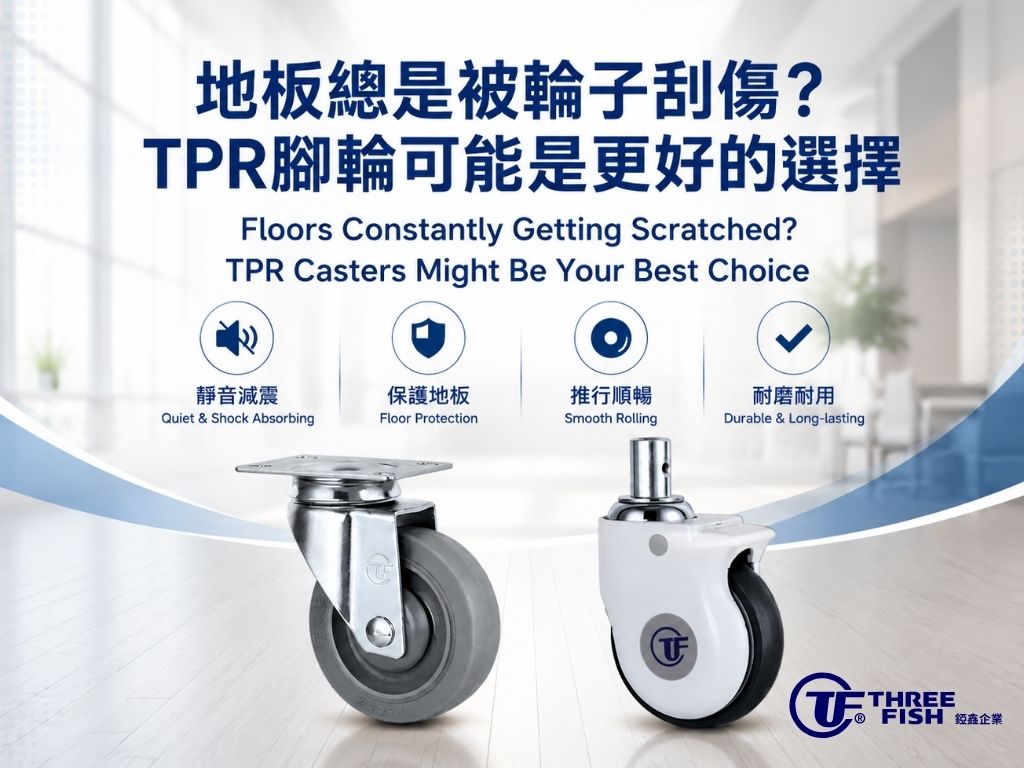
Introduction: Floor Damage is Often the Result of Overlooked Caster Selection
In hospitals, offices, factories, logistics centers, and commercial spaces, the movement of carts and equipment is a daily occurrence. However, many facility managers face a common frustration: once beautiful, pristine floors gradually become marred with scratches, wheel marks, indentations, and surface wear due to long-term equipment transit.
When this issue arises, most people instinctively question the flooring material or the quality of the installation. In reality, one of the most critical factors dictating the lifespan of your flooring is often the choice of casters.
Different caster materials exhibit significant variations in hardness, elasticity, friction coefficients, and load-bearing performance. Particularly in indoor environments featuring hardwood, PVC, tile, or Epoxy flooring, selecting the wrong wheel material not only skyrockets floor maintenance costs but also compromises operational comfort and maneuverability.
In recent years, TPR (Thermoplastic Rubber) casters have emerged as the premier choice for medical equipment, commercial carts, and indoor material handling, thanks to their exceptional balance of silent operation, slip resistance, shock absorption, and superior floor protection.
1. Why Do Wheels Scratch Floors?
Many assume that because wheels simply roll, they shouldn't damage floors. However, from an engineering perspective, the interface between a wheel and the floor is subjected to constant pressure, friction, and impact.
When the weight of the equipment is concentrated at the contact point between the wheel and the ground, an excessively hard wheel material focuses that pressure into a microscopic area. Especially during steering, sudden stops, or crossing expansion joints, localized pressure can spike momentarily, leading to severe surface abrasion.
Furthermore, in industrial and logistics environments, floors are often littered with fine sand, metal shavings, or abrasive dust. When a wheel rolls over these, debris can become trapped between the tread and the floor, acting like sandpaper. Even high-grade industrial flooring will gradually succumb to this continuous grinding.
Therefore, selecting a wheel material with appropriate elasticity and cushioning is vastly more efficient and cost-effective than constantly repairing damaged floors.
2. What is a TPR Caster, and Why Are They Increasingly Popular?
TPR (Thermoplastic Rubber) is a composite material that brilliantly marries the elasticity of traditional rubber with the efficient processing characteristics of thermoplastics.
Compared to standard rubber wheels, TPR offers more consistent manufacturing quality and a cleaner aesthetic. Compared to hard plastics like Nylon, TPR retains excellent resilience and shock-absorbing capabilities.
This unique molecular structure grants TPR an incredibly well-balanced performance profile within the caster industry. Not only does it mitigate vibration and noise during transit, but it also drastically reduces tread-induced floor wear. As a result, it is widely adopted across medical devices, office furniture, hospitality carts, retail displays, and the electronics manufacturing sector.
The reason hospital beds, medication carts, and nursing trolleys can glide silently through patient wards is often precisely because they are equipped with TPR treads.
3. How Do TPR Casters Minimize Floor Damage?
One of the greatest advantages of TPR is its soft, highly resilient tread structure.
When the wheel bears the load of the equipment, the tread micro-deforms, flattening slightly to increase the contact footprint. This characteristic effectively disperses the pressure over a larger surface area, mitigating the risk of floor indentation and damage.
Simultaneously, TPR absorbs a significant portion of kinetic shock and vibration. When crossing tile grouts, uneven surfaces, or thresholds, the tread acts as a built-in shock absorber, ensuring the equipment moves with silky smoothness.
Another highly valued feature is its Non-Marking performance. While traditional black rubber wheels are notorious for leaving stubborn black scuff marks, high-quality TPR treads resist color transfer and marking, keeping your floors looking pristine and professional.
4. Material Comparison: TPR vs. Other Common Casters
| Feature / Material | TPR Casters | PU (Polyurethane) | Nylon Casters | Rubber Casters |
|---|---|---|---|---|
| Floor Protection | ★★★★★ | ★★★★☆ | ★★☆☆☆ | ★★★★☆ |
| Noise Reduction (Silent) | ★★★★★ | ★★★★☆ | ★☆☆☆☆ | ★★★★☆ |
| Wear Resistance | ★★★★☆ | ★★★★★ | ★★★★★ | ★★★☆☆ |
| Load Capacity | Medium | High | High | Medium |
| Rolling Comfort | ★★★★★ | ★★★★☆ | ★★☆☆☆ | ★★★★☆ |
| Indoor Suitability | ★★★★★ | ★★★★☆ | ★★☆☆☆ | ★★★★☆ |
As the comparison illustrates, if your primary application goals are protecting floors, reducing noise, and enhancing pushing comfort, TPR is consistently the most well-rounded and optimal choice.
5. Which Types of Flooring Are Best Suited for TPR Casters?
Different floors demand different caster specifications.
For instance, while hardwood floors are aesthetically pleasing, they are highly susceptible to scratches. To maintain floor integrity, many offices and showrooms prioritize TPR treads to eliminate abrasion risks.
On PVC (Vinyl) flooring commonly found in hospitals, cleanliness and silence are just as important as durability. TPR's non-marking properties make it the undisputed champion for medical environments.
Regarding Epoxy flooring prevalent in electronics manufacturing and logistics, while it boasts high wear resistance, continuous friction from hard wheels will eventually dull and degrade the surface. TPR extends the life of epoxy floors through its lower friction coefficient and superior cushioning.
Tile flooring is another prime application. The hard edges of tile grouts cause rigid wheels to bounce, generating severe noise and vibration. TPR effectively absorbs these impacts, ensuring a fluid and quiet transit.
6. Which Equipment Benefits Most from TPR Casters?
Because TPR casters perfectly combine silence, shock absorption, and floor protection, they are ideal for equipment that requires premium mobility quality alongside environmental preservation.
Common applications include medical carts, hospital beds, mobile IT workstations, document trolleys, retail display racks, hospitality utility carts, and sensitive electronic assembly equipment. These devices operate predominantly indoors, where smooth mobility, acoustic control, and floor care are non-negotiable.
Compared to heavy-duty industrial iron casters, TPR is tailored for scenarios that emphasize ergonomic comfort and user experience over raw, massive load capacities.
7. Real-World Applications: Medical, Office, and Commercial Spaces
The widespread adoption of TPR casters in these sectors stems directly from their functional synergy: silent, shock-absorbing, and gentle on floors. They provide a vastly superior pushing experience compared to harder plastics while safeguarding infrastructure.
In healthcare, beds, medication carts, and diagnostic machines are in constant motion. Loud casters disrupt patient recovery and degrade the healing environment. Hence, top-tier medical OEMs specify TPR treads. TFCaster's medical series pairs specialized TPR compounds with precision bearings to deliver whisper-quiet mobility while preserving hospital PVC and tile floors.
In corporate offices, malls, and exhibition halls, mobile displays and service carts must look professional and operate unobtrusively. TPR's non-marking nature and acoustic dampening make it the perfect match for premium wood, vinyl, or polished concrete commercial floors.
In hospitality, room service and banquet carts must navigate crowded, noise-sensitive areas. TPR treads reduce rolling rumble and reduce physical strain on staff, directly elevating service quality.
TFCaster manufactures over ten professional caster series—spanning light, medium, heavy-duty, shock-absorbing, and medical-grade specifications—allowing clients to perfectly match TPR tread configurations to their precise equipment demands.
8. Beyond Floor Protection: The Hidden Benefits of TPR Casters
While floor protection and noise reduction are the primary reasons for selecting TPR, the material delivers significant compounding benefits.
Firstly, its excellent shock absorption protects the payload. When crossing thresholds or uneven gaps, the tread swallows the kinetic shock, preventing it from transferring to the equipment chassis. For delicate instruments, optical devices, or electronics, this dampening effect is crucial for maintaining calibration and preventing hardware damage.
Secondly, TPR drastically improves the acoustic environment. In noise-sensitive zones like hospitals, libraries, hotels, and open-plan offices, the clatter of hard wheels is highly disruptive. TPR absorbs both sound and vibration, fostering a calmer atmosphere.
Lastly, excellent rolling ergonomics reduce the starting force and pushing resistance for operators, mitigating workplace fatigue and boosting overall efficiency.
9. Key Considerations When Purchasing TPR Casters
When specifying TPR casters, you must evaluate load capacity, wheel diameter, bracket/rig material, and the operational environment in addition to the tread material.
Larger wheel diameters offer superior obstacle clearance and lower rolling resistance. Medical carts typically utilize 4 to 5-inch casters, while industrial applications may require larger sizes.
Bracket material is equally critical. Standard environments can utilize Zinc-plated steel, but for food processing, medical, or high-humidity areas, SUS304 or SUS316 Stainless Steel rigs are highly recommended to prevent corrosion.
Furthermore, bearing design directly influences mobility feel and longevity. High-precision double ball bearings deliver the smoothest tracking and are essential for equipment moved frequently.
Frequently Asked Questions (FAQ)
Q1: Which protects floors better: TPR or PU (Polyurethane) casters?
For pure floor protection, TPR generally performs better. Its softer, more elastic nature disperses weight and reduces localized pressure, making it highly unlikely to scratch wood, PVC, or tile. However, if your equipment carries exceptionally heavy loads, PU may be the necessary compromise. Evaluate based on your specific payload requirements.
Q2: Are TPR casters suitable for factory floors?
Yes, depending on the environment. If the factory floor is relatively smooth and management prioritizes noise reduction, floor preservation, and operator ergonomics, TPR is ideal. However, for ultra-heavy loads, high-temperature zones, or heavily abrasive concrete floors with metal debris, PU, Nylon, or heavy-duty industrial casters are required.
Q3: Do TPR casters wear out quickly?
TPR is more wear-resistant than standard rubber, though slightly less so than ultra-hard PU or Nylon. For low-to-medium load applications like medical carts, office furniture, and retail displays, TPR provides an excellent lifespan. For continuous, heavy-duty industrial towing, higher-wear specifications are recommended.
Q4: Are TPR casters recommended for medical equipment?
Highly recommended. Most modern hospital beds, IV poles, and treatment carts utilize TPR treads. The material provides the critical trinity of medical mobility: silent operation, shock absorption (patient comfort), and floor protection (infection control and facility maintenance).
Q5: Can TPR casters be equipped with brakes?
Absolutely. Most commercial TPR casters can be integrated with various braking mechanisms, including Side Brakes, Total Locks (locking both wheel and swivel), and Central Locking Systems (locking multiple wheels via a single pedal) to ensure maximum operational safety.
Q6: Will TPR leave black scuff marks on my floor?
High-quality TPR casters are engineered with Non-Marking formulas. Under normal use, they will not leave black residue or scuff marks on floors. This makes them the standard for hospitals, malls, and premium corporate spaces where a pristine aesthetic is mandatory.
Q7: How do I know if my equipment needs TPR casters?
Consider TPR if you need to: reduce pushing noise, protect wood/PVC flooring, operate primarily indoors, improve ergonomic pushing comfort, and eliminate ugly wheel marks. If your application demands extreme load capacities or operates in highly abrasive outdoor environments, look toward PU or Nylon.
Floor damage is often viewed merely as a facility maintenance issue, but it actually represents higher repair costs, frequent downtime, and a poor user experience. By specifying the correct caster material at the design phase, you eradicate these issues at the source. For applications prioritizing floor protection, silence, and smooth mobility, TPR casters are undoubtedly the premium choice.
Find the Perfect Caster Solution for Your Equipment: TFCaster specializes in industrial, medical, and specialized mobility solutions. Contact our engineering team today to evaluate your load criteria, flooring conditions, and operational needs to specify the perfect TPR caster configuration for your fleet.