How to Choose Leveling Mounts: A Complete Guide to Load Capacity, Stud Size, and Base Material
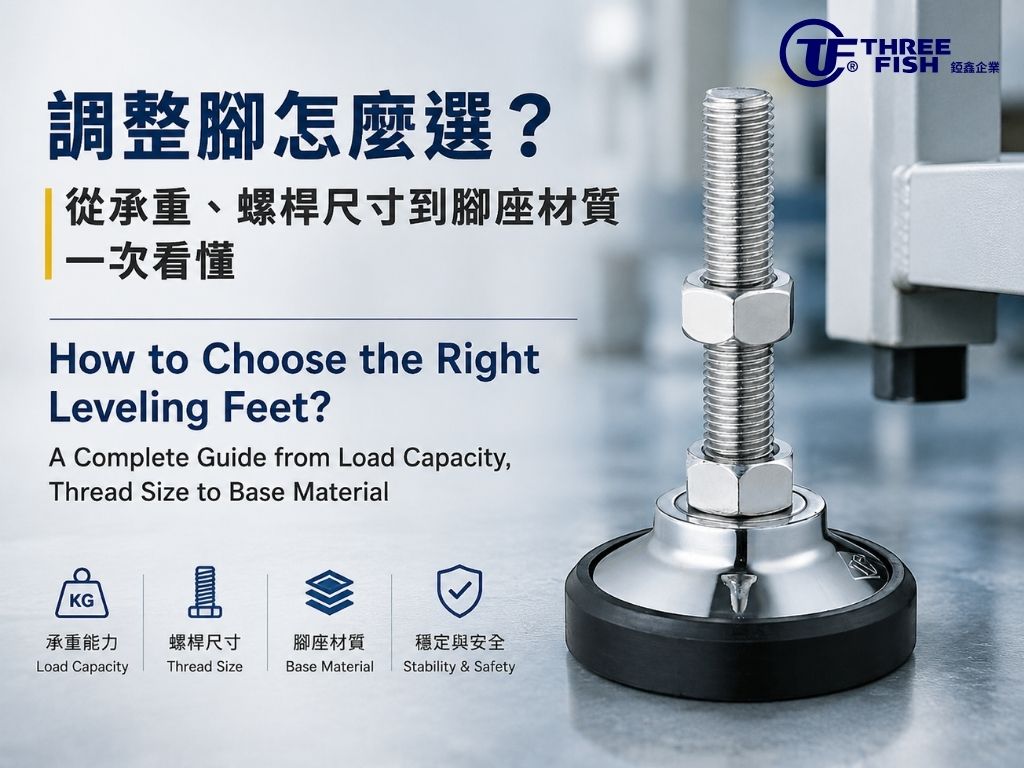
Introduction: Choosing Leveling Mounts is More Than Just "Fitting the Thread Size"
A leveling mount may seem like a minor component at the bottom of your equipment, but it directly impacts whether the machine remains level, stably supported, and safe during long-term operation. Especially in automation machinery, Mechanical Machining equipment, conveyor systems, semiconductor equipment, food processing machines, and workbenches, floors are rarely perfectly level. Therefore, leveling mounts are essential to adjust the equipment's height and maintain a horizontal state.
Der Teng's (TF Caster) leveling mount products not only adjust height and levelness but also offer articulating, heavy-duty, anti-vibration, anti-slip, and stainless steel designs based on varying needs. Material options include aluminum alloy, engineering plastic, galvanized/chrome-plated/nickel-plated finishes, and SUS304/SUS316 stainless steel.
Therefore, selecting a leveling mount requires more than just ensuring the thread fits the equipment. Load capacity, stud size, stud length, base size, base material, floor conditions, and operational characteristics of the equipment must all be thoroughly evaluated.
Table of Contents
1. What Equipment Conditions Should Be Confirmed Before Selection?
2. Key Point 1: How to Determine Load Capacity?
3. Key Point 2: How to Choose Stud Size?
4. Key Point 3: Stud Length and Adjustment Range
5. Key Point 4: Base Size and Structure
6. Key Point 5: How to Choose Materials for the Base and Stud?
7. Dealing with Vibration: Standard vs. Anti-Vibration Leveling Mounts
8. Matching Leveling Mounts to Different Equipment and Environments
9. Quick Guide to Leveling Mount Selection
10. FAQ: Frequently Asked Questions About Leveling Mounts
11. Conclusion: Choosing the Right Leveling Mount Starts with Equipment Conditions
12. Related Articles
1. What Equipment Conditions Should Be Confirmed Before Selection?
Before choosing a leveling mount, it is not recommended to start simply by looking for M10, M12, or M16 thread sizes. A more logical approach is to look at the equipment itself and confirm the actual operating conditions.
First, determine the total weight of the equipment and the number of support points. For example, a 500 kg machine supported by 4 mounts versus 6 mounts will subject each point to a completely different load.
Next, verify the thread specification of the installation holes, the available installation space, and the required height adjustment range. If the thread specs do not match, the mount cannot be installed properly, regardless of its load capacity.
Finally, consider where the equipment will be placed. Is it a standard dry factory, cleanroom, food processing area, or a humid/corrosive environment? Does the equipment vibrate significantly during operation? Is the floor even? These conditions will further dictate the base material and structural design.
The complete selection sequence can be simplified as:
Equipment Weight & Support Points → Mounting Thread → Adjustment Height → Base Size → Operating Environment → Anti-slip / Anti-vibration Requirements
Mastering this sequence is far more efficient than simply searching by product size.
2. Key Point 1: How to Determine Load Capacity?
Load capacity is one of the most critical factors in selecting a leveling mount.
The fundamental concept is to divide the total weight of the equipment by the number of support points. For instance, a 400 kg machine with 4 leveling mounts means each mount theoretically bears 100 kg under perfectly even distribution.
However, real-world equipment is rarely perfectly balanced.
Motors, control panels, machining units, materials, or other heavy components may be concentrated on one side of the machine; uneven floors can also cause certain support points to bear a larger share of the weight. Additionally, dynamic loads generated by startup, shutdown, or operational vibration must be accounted for.
Therefore, you cannot simply use the figure derived from "Equipment Weight ÷ Number of Mounts" as the minimum load capacity specification.
As mentioned in our previous article, "The Cost of Choosing the Wrong Leveling Mount: Equipment Tilt, Excessive Vibration, and Floor Damage," a general rule of thumb is to calculate the average load per mount and then multiply it by a safety factor of 1.3 to 1.5.
For a 400 kg machine with 4 support points, the average load is 100 kg per point. Applying the safety factor, you should look for leveling mounts with a load capacity of at least 130–150 kg each.
However, this remains a general guideline. If the equipment involves significant uneven loading, dynamic impact, vibration, or other special working conditions, the load capacity must be re-evaluated based on actual dynamic loads.
Der Teng's different series also vary significantly in load capacity. For instance, the FE005/FZ005 Trumpet Leveling Mounts offer configurations for 150 kg or 200 kg, while the FY012/FY015 Heavy-Duty Leveling Mounts feature specs for 200 kg and 500 kg. Do not judge load capacity merely by the product's external appearance.
Core Concepts for Load Capacity Selection
| Evaluation Item | Key Considerations |
|---|---|
| Total Equipment Weight | Include the machine body and actual operational payload. |
| Number of Support Points | Confirm how many mounts are actually in use. |
| Center of Gravity | Watch out for uneven loading caused by motors or materials. |
| Equipment Vibration | Dynamic loads cannot be judged by static weight alone. |
| Safety Margin | Avoid keeping leveling mounts at their extreme load limits for prolonged periods. |
3. Key Point 2: How to Choose Stud Size?
Many people search directly for "M12 Leveling Mounts," "M16 Leveling Mounts," or "M20 Leveling Mounts." The 'M' represents the nominal diameter of the metric thread.
- M10: Approx. 10 mm nominal diameter
- M12: Approx. 12 mm nominal diameter
- M16: Approx. 16 mm nominal diameter
- M20: Approx. 20 mm nominal diameter
However, a thicker stud is not necessarily better.
The first criterion should be the equipment's original mounting thread specification. If the equipment frame is designed for M12, you must choose a compatible stud and thread pitch, rather than upgrading to a larger size simply because it seems stronger.
Furthermore, even if it is M12, you must ensure the thread pitch matches.
Taking Der Teng's FE005/FZ005 Trumpet Leveling Mounts as an example, you can find combinations like M10 with P1.5, or M12 with P1.75. The FY012/FY015 Heavy-Duty series includes specs like M12 P1.75 and M16 P2.0.
Therefore, you should at least confirm:
Stud Diameter + Thread Pitch + Mounting Hole Specification
All three must match to ensure proper installation.
Additionally, stud size should not be used in isolation to judge load capacity. Even with a thicker stud, it must be evaluated alongside the base structure, stud material, and overall product design. Always refer to the product's actual rated load capacity.
4. Key Point 3: Stud Length and Adjustment Range
Choosing the right M12 or M16 is not enough; another frequently overlooked spec is stud length.
Stud length affects the height adjustment range. If the stud is too short, you may lack the necessary travel distance to achieve leveling on floors with significant height variations.
Conversely, longer is not always better.
Extending the stud significantly for long periods to increase equipment height alters its load-bearing mechanics. Therefore, select a stud length based on normal installation height and floor variations, rather than simply defaulting to the longest option.
For example, Der Teng's FE005-50-10 series offers lengths like 50 mm and 100 mm; the FY012 series offers 100 mm and 150 mm. This shows that even with the same series and thread size, different lengths can be selected based on installation needs.
We recommend measuring the following before purchasing:
The expected height from the equipment base to the floor, the maximum floor variation, and the effective stud length required after achieving levelness.
This prevents discovering insufficient adjustment travel only after the equipment arrives on-site for installation.
5. Key Point 4: Base Size and Structure
The base is the part that actually contacts the floor, making its dimensions and structure just as important as the stud.
A larger base generally provides a greater contact area, helping to distribute the equipment's weight. However, whether a large base is necessary depends on equipment weight, installation space, and floor conditions.
Large automation equipment may require a wider, more stable support surface, whereas compact machines with limited bottom clearance must ensure the base does not interfere with other mechanisms, covers, wiring, or peripheral equipment.
Furthermore, some equipment requires being bolted down to the floor in addition to horizontal leveling.
For instance, the bases of Der Teng's FY012/FY015 Heavy-Duty Leveling Mounts are stamped and feature anchor holes (bolt-down holes)—the Y012 has a Φ14 hole, and the Y015 has a Φ20 hole. These are ideal for automation machinery, aluminum extrusion frames, AS/RS systems, and semiconductor equipment.
Therefore, ask these three questions when selecting a base:
- Does the equipment need a large floor contact area?
- Is there sufficient installation clearance around the base?
- Does the equipment need to be anchored to the floor using the base?
If anchoring is required, confirm that the base features appropriate bolt-down structures during the selection phase.
6. Key Point 5: How to Choose Materials for the Base and Stud?
Material selection largely depends on the equipment's operating environment.
Der Teng's leveling mount series currently offer materials like aluminum alloy, engineering plastic, and finishes like zinc-plated, chrome-plated, nickel-plated, black electrophoretic iron (e-coating), and SUS304/SUS316 stainless steel. These options aren't just price tiers; they respond to specific environmental demands.
General Industrial Environments
For standard dry factories, automation equipment, workbenches, or conveyors, you can select suitable metal or plastic bases based on load capacity, budget, rust prevention, and structural needs.
Standard industrial settings do not necessarily require the highest-grade stainless steel. The focus should remain on ensuring load capacity, dimensions, and actual environmental compatibility match the product design.
Humid or Washdown Environments
Food processing, beverage lines, and certain medical and lab equipment often encounter moisture or require frequent washdowns. These environments demand high corrosion resistance and ease of cleaning.
Der Teng offers SUS304/SUS316 stainless steel options tailored for food processing, beverage lines, and other environments requiring superior corrosion resistance.
Floor Protection and Anti-Slip Requirements
Beyond the metal body, whether the base bottom features anti-slip or cushioning designs impacts actual performance.
Especially on tiles, PVC, epoxy flooring, or surfaces requiring protection, mismatched base materials can lead to sliding, scratching, or indentations.
Thus, evaluate equipment weight, floor material, and anti-slip needs holistically, rather than looking solely at the mount's core material.
7. Dealing with Vibration: Standard vs. Anti-Vibration Leveling Mounts
If the equipment generates continuous vibration during operation, standard leveling functions may fall short. In such cases, anti-vibration leveling mounts should be evaluated.
Standard mounts primarily support equipment and adjust height for levelness. Anti-vibration products go a step further to account for operational vibrations.
Der Teng's current product line includes shock-absorbing mounts, FTF018 heavy-duty anti-vibration mounts, and FTF019/FTF020 precision anti-vibration mounts, catering to dampening, noise reduction, and anti-slip needs.
Therefore, if the equipment involves high-speed machinery, precision equipment, or noticeable vibration, anti-vibration capability should be a selection criterion.
However, vibration sources vary (motors, eccentric motion, machining loads, floor resonance, or the machine structure itself). Anti-vibration mounts cannot replace comprehensive vibration analysis.
If the equipment has strict requirements for machining precision, measurement stability, or vibration control, first identify the vibration source, equipment weight, and operating conditions before selecting the appropriate shock-absorbing structure.
8. Matching Leveling Mounts to Different Equipment and Environments
Integrating the aforementioned criteria allows for a rapid selection direction based on applications.
| Use Case / Scenario | Primary Selection Considerations |
|---|---|
| Automation Machinery | Load capacity, stud specs, leveling, equipment vibration |
| Mechanical Machining Equipment | Load capacity, rigidity, horizontal stability, anti-vibration needs |
| Semiconductor / Precision Equipment | Horizontal stability, cleanroom compatibility, micro-adjustment |
| Food Processing Equipment | Stainless steel, corrosion resistance, washdown readiness |
| Conveyor Systems | Installation height, stud size, horizontal leveling |
| Heavy-Duty Equipment | Single-mount load limit, base size, floor anchoring method |
| Uneven Floors | Adjustment travel, articulating structure, base contact |
| Vibrating Equipment | Shock-absorbing structure, load vs. vibration profile |
Der Teng's applications span manufacturing and industrial equipment, electronics and semiconductor, medical and laboratory, food processing, logistics warehousing, and heavy industries. Selection should start with the industrial environment and equipment conditions before narrowing down specific product ranges.
9. Quick Guide to Leveling Mount Selection
If you are unsure where to start, follow this sequence for selection.
Step 1: Confirm Total Equipment Weight
In addition to the machine body, include workpieces, materials, jigs, and dynamic payloads during normal operation in your evaluation.
Step 2: Confirm Support Points and Weight Distribution
Calculate the average load per support point, then check if there is uneven loading caused by motors, control panels, or other heavy components.
Step 3: Confirm Mounting Thread
Verify the M-size and thread pitch; do not rely solely on the visual diameter of the stud.
Step 4: Confirm Stud Length and Adjustment Height
Based on the equipment's ground clearance, installation method, and floor height variations, confirm the required effective adjustment range.
Step 5: Choose Base Size and Structure
Verify base dimensions, equipment bottom clearance, floor contact conditions, and the need for anchor holes.
Step 6: Select Material Based on Environment
Standard dry factories, humid environments, food processing areas, and cleanrooms have different operating conditions and require different materials.
Step 7: Assess Needs for Anti-Slip, Articulating, or Anti-Vibration Features
Finally, determine if extra features are needed based on floor conditions and machine dynamics.
In other words, leveling mount selection is NOT:
"My equipment takes M16, so I'll just buy an M16 leveling mount."
It SHOULD be:
"How heavy is my equipment, how many support points are there, what is the mounting thread spec, how much height adjustment is needed, what is the operating environment, and will it vibrate during operation?"
Clarifying these conditions makes finding the truly appropriate leveling mount much easier.
FAQ: Frequently Asked Questions About Leveling Mounts
Q1: How do I calculate the required load capacity?
Divide the total weight by the number of support points to estimate the average load, then factor in weight distribution, vibration, and safety margins.
As mentioned in our previous article, "The Cost of Choosing the Wrong Leveling Mount," a general rule is to apply a 1.3 to 1.5 safety factor. However, the final requirement must be confirmed based on actual uneven loading, vibration, and working conditions.
Q2: What is the difference between M12 and M16 mounts?
M12 and M16 represent the nominal thread diameter. However, selection goes beyond size comparison; you must ensure mounting holes, thread pitch, load capacity, stud length, and structural design fit your needs.
Q3: Does a thicker stud guarantee higher load capacity?
Not necessarily. Stud diameter is just one factor influencing load capacity. Base structure, stud material, base design, and overall product specifications are equally crucial. Always refer to the manufacturer's actual rated capacity.
Q4: Can standard mounts be used on uneven floors?
If the height variation is within the product's adjustment range, standard mounts can level the machine via the stud height. For complex angles or poor floor contact, articulating (swivel) bases are recommended.
Q5: Which equipment requires anti-vibration mounts?
If the machine generates noticeable vibration or demands high stability, low noise, and precision, anti-vibration products should be evaluated. However, selection depends on the vibration source, weight, and working conditions, not just the presence of a rubber pad.
Conclusion: Choosing the Right Leveling Mount Starts with Equipment Conditions
Selecting a leveling mount is not finished once you find a matching thread size.
Every aspect—from load capacity, support points, thread specs, and stud length to base size, materials, anti-slip properties, anchoring, and anti-vibration needs—impacts post-installation stability and long-term performance.
If you only verify M12 or M16 sizes while ignoring equipment weight, center of gravity, floor conditions, and the working environment, a successful installation doesn't guarantee it's the optimal choice.
Der Teng (TF Caster) provides a wide range of articulating, heavy-duty, anti-vibration, anti-slip, and stainless steel leveling mounts. With varying stud, base, and load specifications, we meet the support needs of automation equipment, semiconductor tools, food machinery, logistics warehousing, and various industrial applications.
If you are selecting mounts for new equipment, we recommend documenting the equipment weight, support points, thread specs, installation height, floor environment, and vibration profile prior to product selection.
For special dimensions, materials, load ratings, or equipment application needs, please contact Der Teng (TF Caster). We will help you evaluate the most suitable leveling mount configuration based on your actual equipment and operating environment.